Transition Year
The Salerno Transition Year Curriculum has been developed in accordance with The Transition Year Programme Guidelines for Schools (Dept. of Education & Youth).
Our Approach
The Transition Year Programme in Salerno offers pupils space to learn, mature and develop in the absence of examination pressure.
There is a clear distinction between the Transition Year Programme and the corresponding Leaving Certificate syllabus. The curriculum offers a challenge to pupils in all areas of their development which includes intellectual content. On completion of Transition Year, students should be more equipped and disposed to study than their counterparts who did not have the benefit of this year. The curriculum is designed so that students become reflective young adults that are more prepared for the Leaving Certificate and the world of work.
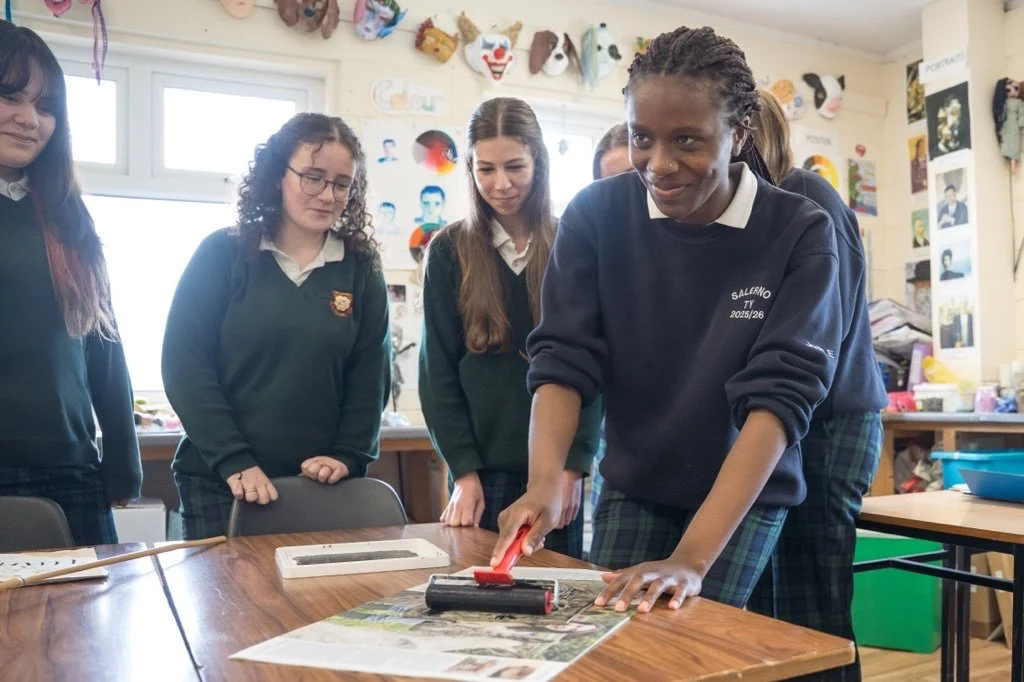
The Transition Year timetable includes three weekly classes of the core subjects of Irish, English, Maths and a foreign language. In addition to these, Transition Year students spend ten weeks studying each of the optional Leaving Certificate subjects as well as several other TY specific subjects that they would not otherwise have the opportunity to study.
The TY Programme Statement is designed to provide schools with a flexible, collaborative approach to planning programmes for their context.
The local autonomy of schools, working within the parameters of the TY Programme Statement, is fundamental to fostering school-led innovations, promoting equitable access and offering young people transformative experiences that will ground them throughout senior cycle and into their future lives.
Schools can adapt their TY curriculum so that students have opportunities to develop the key competencies to thrive and flourish in this rapidly changing world. A programme aligned to the TY Programme Statement is inclusive and embraces diversity, facilitates a sense of discovery, reports more broadly on student learning and development, and values the contribution each student can make to the programme.
During TY students can develop more mature relationships with teachers and other adults, becoming more active agents in designing their own educational experiences. Participation in TY contributes to the continuing learning and development and personal growth of students.
All students are supported throughout TY to become more adaptable, empathetic, competent and resilient human beings; qualities which are modelled by the school community, evident in the nature of the TY programme itself and valued within the local community.
Through a creatively school-designed TY curriculum, all students can avail of opportunities to grow and develop, learning to make more informed choices in senior cycle and beyond.
Transition Year (TY) is a one-year optional programme that takes place between Junior Cycle and Senior Cycle (Leaving Certificate). It offers students an important opportunity to broaden their learning experiences, develop new skills, and prepare for the challenges of senior cycle and life beyond school.
What Is the Purpose of Transition Year?
According to the NCCA Transition Year Programme Statement, TY is built around a student-centred vision that:
Supports personal, social and academic development,
Fosters independence, creativity and critical thinking,
Encourages responsibility and active citizenship, and
Helps students make informed choices about their future learning and career pathways.
This means that TY isn’t focused on a high-stakes final exam but instead on developing real-world skills and confidence in a supportive learning environment.
What Students Learn and Do During TY
Each school designs its own TY programme to reflect its values and the interests of its students, but most programmes include:
Wide-ranging learning experiences
A mix of traditional subjects and new modules or project-based learning.
Opportunities to sample senior cycle subjects to help inform subject choices for 5th Year.
Work experience and community engagement
Students take part in work placements to explore career areas and develop workplace skills.
Many programmes include volunteering, civic engagement, and sustainability projects that connect learning with life beyond school.
Personal development
TY supports communication, teamwork, leadership, resilience and problem-solving skills.
Students often engage in workshops, field trips, guest speakers, and reflective portfolios to capture their learning journey.
Why Transition Year Matters
TY helps students to grow in confidence, explore their interests, and gain a better sense of who they are as learners and young adults. It acts as a bridge between the structured learning of the Junior Cycle and the more independent, self-directed learning of Senior Cycle.
More Information and Supports
For parents who want to explore the Transition Year Programme in more depth, these official supports are helpful:
National Council for Curriculum and Assessment (NCCA) – information on the TY Programme Statement and curriculum supports: Click Here
OIDE – Support Service for Schools – resources and guidance for schools and teachers implementing the TY framework